Cheong Fatt Tze or Tjong Tjen Hsoen (張弼士) (1840–1916) was a Chinese businessman and politician. He was a powerful Nanyang industrialist and a first-class Mandarin in the Manchu government; he was made Consul-General in Singapore and economic advisor to the Empress Dowager. The road, Jalan Cheong Fatt Tze, is named after him.
He was born in 1840 in Dabu, Guangdong Province in South China. As he came from a poor Hakka family, he started working at an early age as a cowherd back in his village. In 1856, civil war ravaged much of China, and in that same year another war had broken out between the Emperor of China and the English, known as the Second Opium War (1856–1862). The people had experienced hardship and suffering during the war. As a result, Cheong Fatt Tze migrated to South-East Asia together with other coastal Chinese families to seek their fortune.
He started as a water-carrier and then became a shopkeeper in Jakarta, Indonesia. After his marriage, he established a trading company with the help of his father-in-law. Gradually, he began to accumulate his wealth through hard work and perseverance. In 1877, he expanded his business from Jakarta to Medan. His business was based on agricultural products such as rubber, coffee and tea but he branched out to the financial sector by acquiring a bank. This move made him a wealthy man.
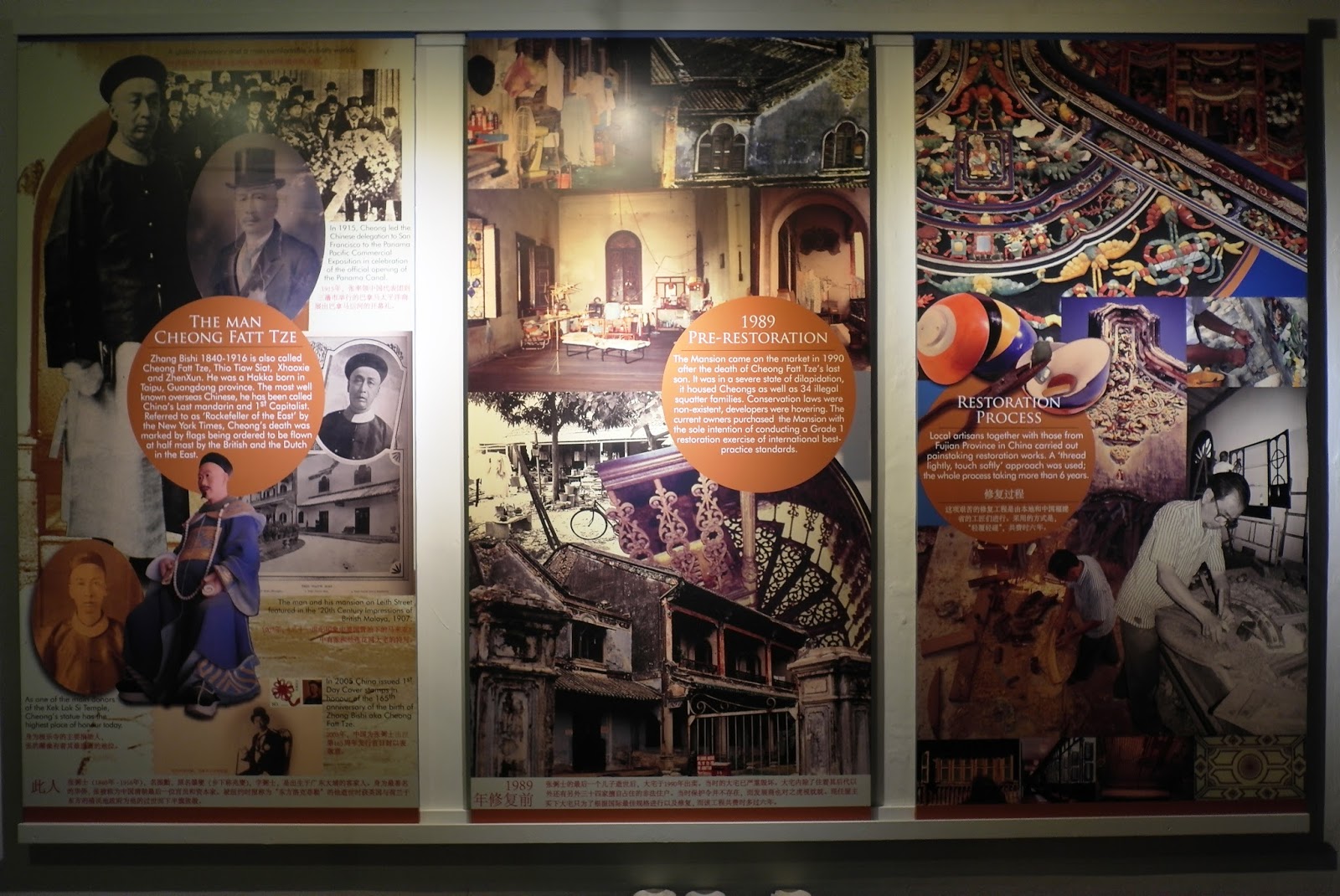
In 1886, he expanded again to Penang, Malaysia. As his business grew, he owned three ships which plied between Penang and Sumatra. In the course of his work, he occasionally resided in Penang and owned a mansion in Leith Street, which stands to this day as protected heritage building, The Blue Mansion.
In 1890, in recognition of his hard work and contribution, he was appointed the Chinese Consul, based in Penang. This office was shifted to Singapore when that city became established as a well-known trading port in South-East Asia. As the Chinese Consul, he worked tirelessly for the interests of overseas Chinese residents through diplomatic channels with the British authorities.
In 1899, he was summoned to China twice by the Emperor of China and instructed to present a national development plan, which was well received by the government of the Qing dynasty. As a result, he was promoted to be the Minister for agriculture, industries, roads and mines for the provinces of Fujian and Guangdong. Later he was instructed to conduct a study of trade and education in Penang and Singapore. Subsequently, the Singapore Chinese Chamber of Commerce was established. In 1904, he established the first Chinese school in Southeast Asia, the Chung Hwa Confucian School in Penang.
In 1912, the Kuomintang overthrew the Qing and established a republican government. Cheong was appointed as a member of the Legislative Assembly so that he could be actively involved with politics. He was also appointed as the Chairman of the Chinese national Chamber of Commerce, which was well received by all parties.
In 1915, he was sent to the United States to study all aspects of industrialization of that nation. During his journey, when he stopped over in Hong Kong, he was awarded a Ph.D. in Law.
Cheong Fatt Tze died in Indonesia in 1916. His body was sent back to China to be buried. On its final journey through Penang, Singapore and Hong Kong, the overseas Chinese were greatly saddened by the loss of this great personality. The Chinese government sent a high-ranking official to his funeral and ordered the National Archives to record his life in historical documents so that his contributions would always be remembered. Both the British and the Dutch authorities ordered flags to be flown at half-mast to honor the man who was known as "the Rockefeller of the East". He had eight wives and owned many residences throughout his trading empire (mostly Southeast Asia) but made Penang his base, where he raised his six sons.
A street in Penang, state of Malaysia, which was formerly named Hong Kong Street was renamed after him, Jalan Cheong Fatt Tze. His blue mansion, Cheong Fatt Tze Mansion, is a heritage building, located at Leith Street, Penang. He has another mansion in his birthplace, Dabu, Guangdong Province, China.



 |
| WIFE NO.7, TAN TAY POH WHO IS ALSO A FAVOURITE WIFE OF CHEONG FATT TZE |
 |
| THE LEGEND, CHEONG FATT TZE |